
The Location Finland platform is part of Location Innovation Hub’s test infrastructure, aiming to support the development of location-based services and speed up experimentation. The platform uses modern Open Geospatial Consortium (OGC) standards. The Location Innovation Hub is a centre of expertise for location information and technology, coordinated by the Finnish Geospatial Research Institute (FGI).
"Location Finland is the first Finnish platform where data from multiple providers can be integrated under a single API, thereby simplifying application development. Data integration is crucial for the data economy, as without it, data remains siloed and its value remains unrealised. Combining data creates value — for example, combining 3D building data with IoT sensor data enables energy simulations and the development of digital twins," explains Antti Jakobsson, Project Manager at Location Innovation Hub.
The platform was developed by the Finnish Geospatial Research Institute (FGI) of the National Land Survey of Finland in collaboration with Finnish data providers. Datasets are available from the following organisations: the National Land Survey of Finland, the Finnish Environment Institute, the Natural Resources Institute Finland, the Finnish Meteorological Institute, Forum Virium Helsinki, Oulu University of Applied Sciences, the City of Helsinki, and Telia.
Practical data utilisation through examples
Location Finland provides sample data across various themes, including the built environment, agriculture and food production, forestry, transport, health and wellbeing, and climate. Users can explore data through practical examples that demonstrate how businesses can leverage location-based data to develop services.
For instance, in agriculture, location-based data is a key tool for optimising operations. By combining yield data, aerial imagery, and field maps, it is possible to visualise clearly how different areas perform.
"Production inputs are used most effectively when applied as timely and location-specific as possible - that is, where they are needed most," says Senior Researcher Katariina Pussi from Natural Resources Institute Finland.
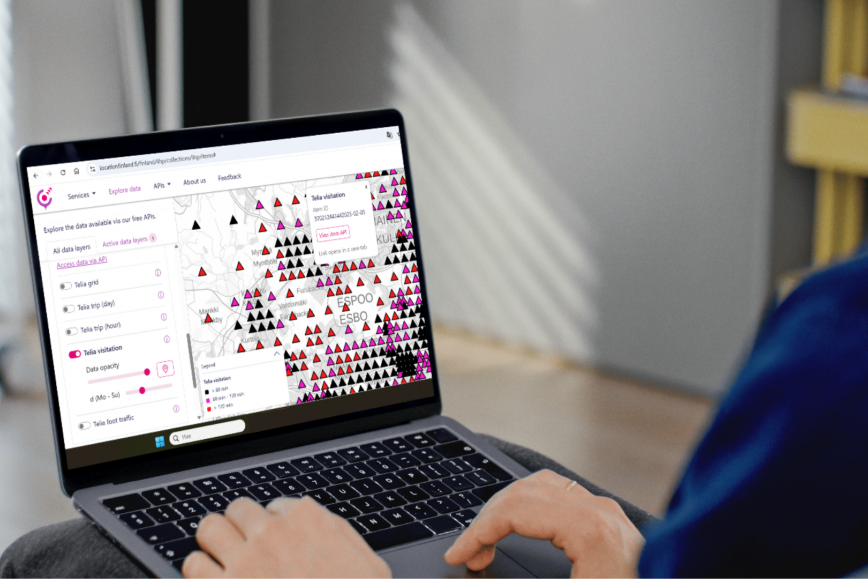
Location Finland’s Smart City datasets, including Telia’s mobility data for Helsinki and Espoo, support smart urban planning.
A national test platform complementing Location Europe
Location Finland follows the same principles as the previously launched Location Europe platform. Both provide free access to geospatial datasets via APIs, but while Location Europe harmonises data across Europe, Location Finland focuses on datasets produced in Finland. It also includes data from geographically limited test areas that are not easily available elsewhere.
The development of test platforms continues in Location Innovation Hub’s next phase towards data spaces. In data spaces, the key is that data producers and owners can decide who can access the data and under what conditions. They also provide a secure solution for sharing data and data-driven analyses.
Getting started with Location Finland
- Explore the platform: locationfinland.fi
- Benefit from data: Get a free API key and start testing.
- Develop your own use case: Location Innovation Hub offers free consultation on how the platform can be used for your purposes. Contact the Location Innovation Hub.
- Share your organisation’s data: Make data more accessible through APIs. Contact the Location Innovation Hub.
- Join the webinar on 29 January 2026: Learn more about using Location Finland and see the platform in action. The event is open to both data users and producers. The detailed programme and registration will be published soon.
Further information
Antti Jakobsson, Project Manager, firstname.lastname@nls.fi, +358 50 599 4123