

This was the second time that the National Land Survey has carried out a carbon footprint calculation. As the same method of implementation was used as before, the Greenhouse Gas Protocol Corporate Standard, this allowed us to use comparable amount and sources of emissions.
Total carbon footprint of the National Land Survey of Finland
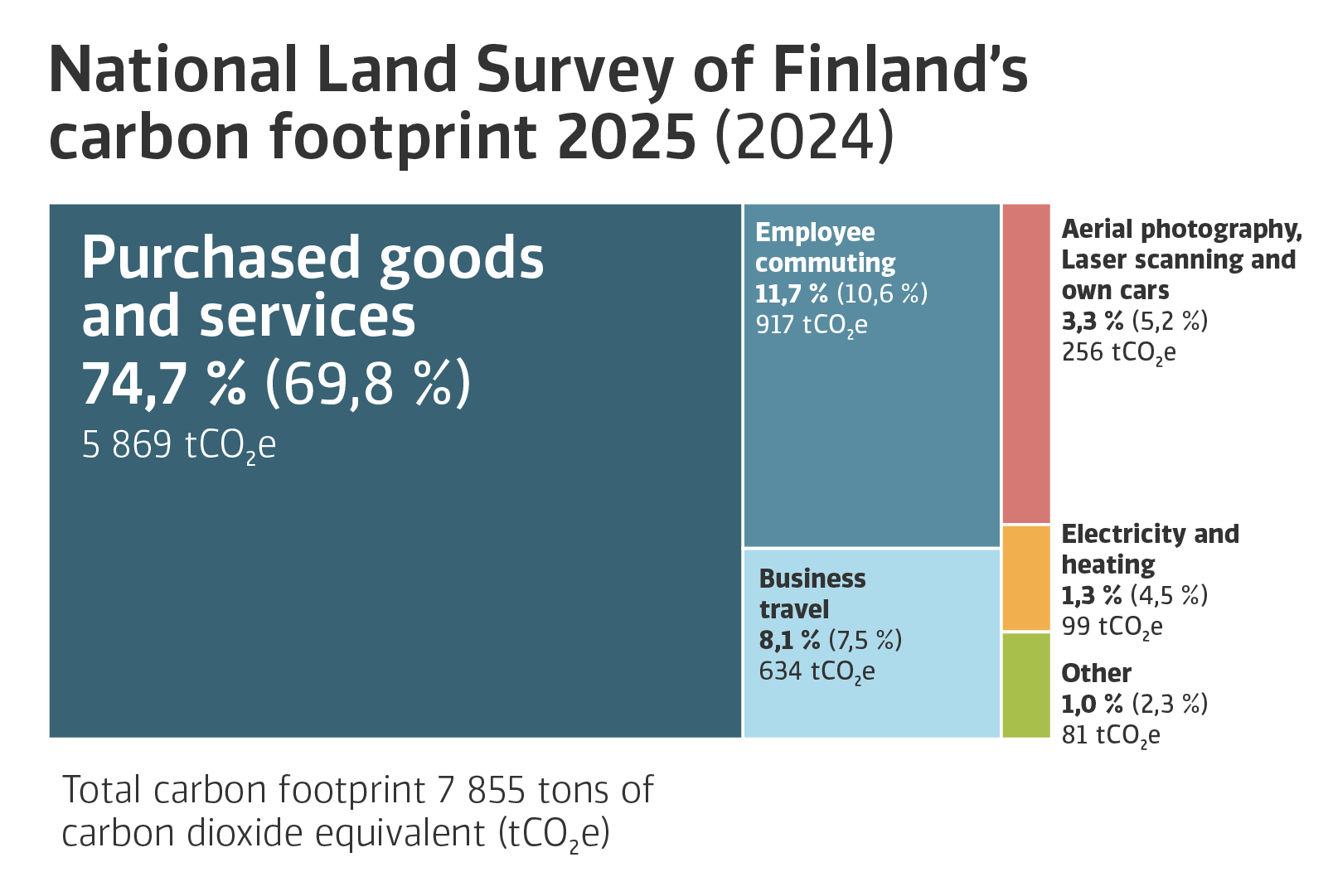
- 2025: 7,855 tonnes of carbon dioxide equivalent (tCO2e), approximately 4.6 tCO2e per employee.
- 2024: 7,159tonnes of carbon dioxide equivalent (tCO2e), approximately 3.9 tCO2e per employee.
Our emissions increased by about 10 %, which is about 18 % per employee.
More accurate data, the improvement of the use of the calculation method, and operational changes were the primary contributors of growth. Our largest source of emissions is procurement, which is typical of an expert organisation such as the National Land Survey. Procurement must continue to be carried out sustainably and responsibly while ensuring that total emissions remain under control.
Major emission sources in 2025, share and tCO2e (in brackets, share in 2024)
“Performing the calculation boosted our shared understanding of the National Land Survey's emission sources. This information now will help us come up with ways to control our carbon footprint. We want to keep raising awareness and develop our expertise in sustainable procurement across the National Land Survey,” says Director of Communications Mirva Kipinoinen.
Act of sustainability: Carbon footprint calculation as an internal project
This was the first time that the National Land Survey had its own experts carry out the emission calculation. In doing so, we also achieved one of this year's acts of sustainability: calculating the carbon footprint as an internal project, which also raised awareness of the sources of emissions and the organisation's own calculation expertise.
Achieving 50 acts of sustainability is becoming reality
The National Land Survey's sustainability work is guided by our sustainability programme, Responsibility for the Earth. We report on the progress of the objectives annually. Every year, we monitor and advance our sustainability goals through concrete acts of sustainability.
We are committed to advancing 50 acts of sustainability by the end of 2027. We had already carried out 49 of these actions by the end of 2025.