

In the Mobile Solutions for Removing Foreign Cereal Crops (MOVI) project, foreign grains such as barley growing among pure oats are identified with precise drone images. Artificial intelligence analyses the images and produces coordinates for locating the plants in a field.
The project is also developing a mobile application that provides an optimised route for farmers to get directly to the foreign grain. With the locations of the foreign grains displayed directly on a mobile phone, it becomes a quick and accurate process to weed the foreign grains. This reduces the workload and improves the quality of pure oats.
“The aim is to make it as efficient and accurate as possible to identify and remove foreign grains with the latest geospatial and artificial intelligence technologies,” says Roope Näsi, Senior Researcher at the Finnish Geospatial Research Institute FGI.
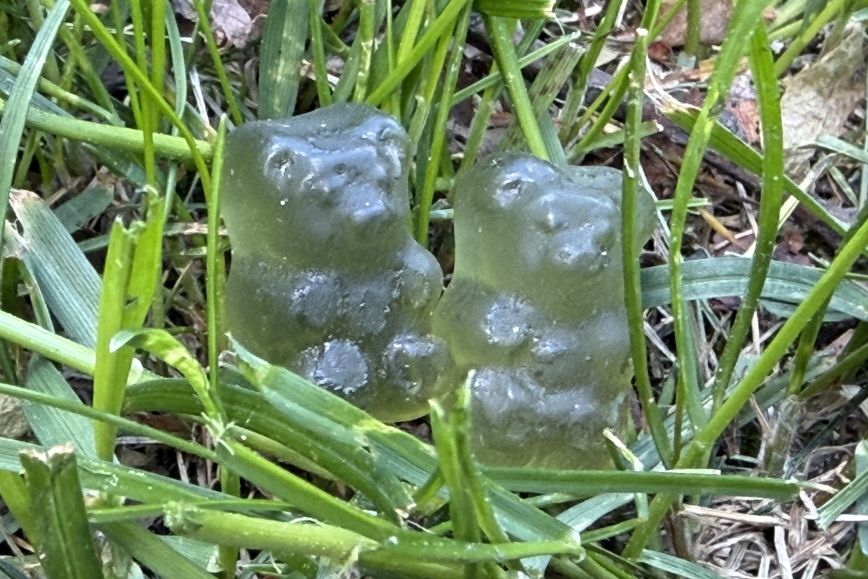
Gummy bears imitate grains
Before the actual field trials, which took place in early July, a test environment was built in Tapiola, Espoo. There, various objects were spread on grass to resemble foreign grains in an oat field in terms of appearance and detectability.
After several trials, gummy bears turned out to be the best option: they did not attract birds or stand out too easily, but were still sufficiently noticeable.
“Surprisingly, it was gummy bears that were the best at simulating foreign grains. In particular, the green and translucent candies were a good match for actual field observations,” says Näsi.
Foreign grains were easy to find in summer
In early July, the camera and cutter drone and the mobile app, were tested in an oat field in Isokyrö, and the results were encouraging. The method proved notably reliable at detecting foreign grains in a pure oat field from precise drone images, and the app made it easier to the grains in the field. One part of the trial was to attach a cutter to the drone, which would descend to the foreign grains based on coordinates. The method can make farmer work easier if it can eliminate weeding by hand and allow the cutter drone to carry out the work.
The identification of foreign grains was demonstrated in Kyrönmaa and Lapua in late June and early July at seven pure oat fields, which belonged to different farmers.
“The images collected during the demonstration were sent to the Finnish Geospatial Institute in Otaniemi, where they were analysed with artificial intelligence and photogrammetry. The following day, the location coordinates of the foreign grains were ready to transfer to the mobile app for weeding. The method worked even better than expected,” says Näsi. According to him, it particularly motivates him as a researcher to receive positive feedback from the innovation group of pure oat producers involved in the project, along with new development ideas for refining the method further.
Pure oats, or gluten-free oats, are the only type of oats suitable for a celiac diet. The solutions developed in the MOVI project benefit clean oat producers in particular, but will also lay the foundation for broader identification of weeds and digitalisation of agriculture.
Further information
Roope Näsi, Senior Researcher, Finnish Geospatial Research Institute FGI, tel. +358 50 523 1674, firstname.lastname@maanmittauslaitos.fi
MOVI is a European Innovation Partnership (EIP) project with funding from the EU’s rural development fund. The funding was granted by the South Ostrobothnia ELY Centre (now the Economic Development Centre).