

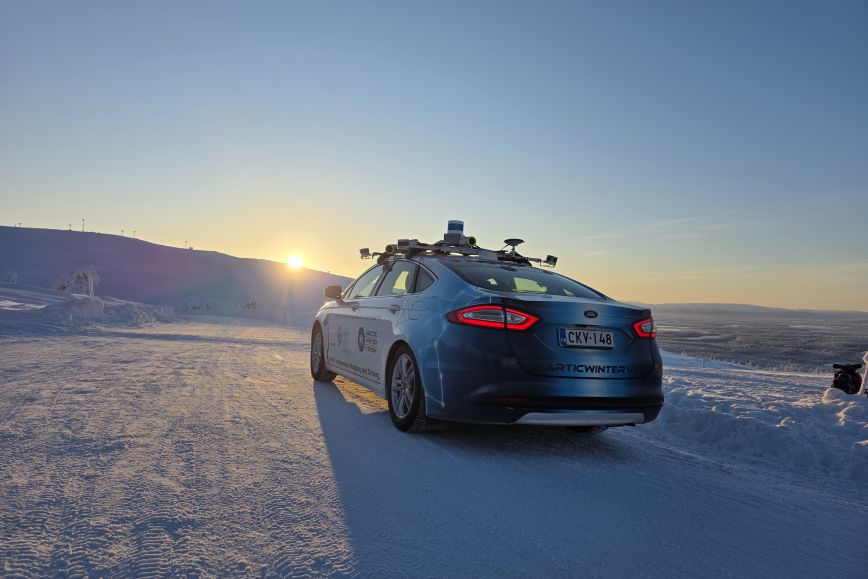
Rain, fog and snow are among the main challenges of automated driving. While the vehicles perform well in sunny weather, northern winter can virtually blind their sensors.
The ROADVIEW study focused especially on how an automated vehicle can not only understand its environment, but also assess the reliability of its sensor information under changing weather conditions. To this end, a system was developed to offer environmental observation, accurate localisation, driving-related decision-making and function validation in a single package.
“Self-driving cars still need to be developed further before they can drive safely on public roads. Vehicles currently in use operate in confined areas with easy driving conditions. The vehicles need parallel systems with complementary perception that improve the system's reliability in difficult weather conditions or against intentional interference with localisation”, says Heikki Hyyti, Senior Research Scientist at the Finnish Geospatial Research Institute FGI.
Improvements in localisation and perception of the environment
One of the technologies used by automated vehicles is laser scanning, where laser scanners attached to a vehicle form a three-dimensional model of their environment, a point cloud.
In the study, a method was developed that can be used to remove inaccuracies caused by bad weather from the point cloud. Automatic environmental perception and object recognition improved compared to a situation where such weather-induced artefacts were not removed.
Another important research focus was reliable position localisation. Automated vehicles need precise location information even when no satellite position signal is available. In the study, a system based on laser scanning was developed that allows the vehicle to locate itself by comparing its environment with an accurate digital HD map of the environment. This method allows the vehicle to reliably locate itself even when satellite positioning is not working or is disturbed.
“The vehicle positioning method we developed, based on laser scanning and HD maps, was tested under different conditions: with a lorry on a motorway in Istanbul, Turkey; with a van in foggy and rainy conditions of a weather test hall in Germany; and with a passenger car in winter conditions in Muonio, Finland. Tests showed that positioning based on HD maps provides a viable alternative to satellite localisation. The method worked reliably even in challenging conditions and with different vehicles”, says Heikki Hyyti.
A new way to detect slipperiness
Researchers from the Finnish Geospatial Research Institute also developed a groundbreaking method that identifies slippery spots on the road from the image of the vehicle's front camera. The method is based on deep learning, and has been trained using slipperiness values obtained from the road weather sensor. Slipperiness detection was tested in different situations, and it successfully detected the potential slipperiness of the road, especially in snowy and wet driving conditions.
The study collected sensor data in different weather conditions in all seasons, including rainy, foggy and snowy conditions. In addition, the functional reliability of LiDAR sensors was tested at temperatures ranging from -30 °C to 50 °C.
In addition to a real-life driving environment, the technologies were evaluated under controlled conditions in a weather test hall in Germany. The test hall is able to simulate rainfall intensities of up to 120 millimetres per hour, poor visibility and different lighting conditions.
The results of the project will help to make automated vehicles safer and more reliable and support their future deployment on public roads. The European Union-funded project involved 15 industry and research representatives from 7 countries.
Further information
Senior Research Scientist Heikki Hyyti
+358407718099, firstname.lastname@nls.fi
Watch the video presentation on road slipperiness detection and other methods developed in the research on the ROADVIEW project's YouTube channel.
Learn more about the research results on the project website.
Funded by the European Union (funding decision no. 101069576). The views and opinions presented only belong to the authors of the text, and may not match those of the European Union or the European Climate, Environment and Infrastructure Executive Agency (CINEA). The EU or CINEA are not responsible for them. 