

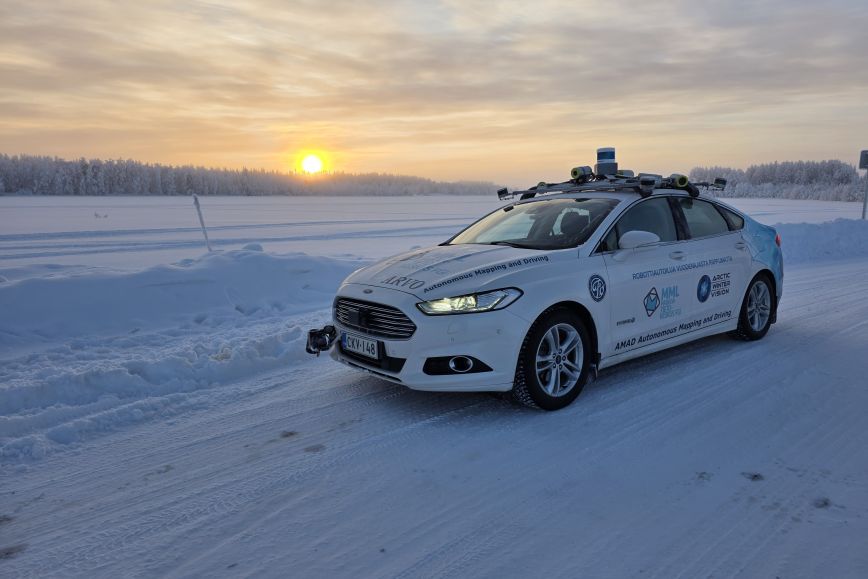
In order for autonomous vehicles to survive in Finland’s arctic conditions, they must be able to operate on dark and slippery roads, for example. At the same time as autonomous vehicles are becoming more common around the world, Finland and other Arctic countries must be able to ensure that the vehicles can operate reliably also in challenging weather conditions. The EU-funded Roadview research project focuses on this challenge by investigating and developing technological solutions.
“As autonomous transport becomes more common, it must also be able to operate in Finland. If autonomous vehicles operate elsewhere, but not in our weather conditions, the Nordic countries will be excluded from this development. Therefore, studying autonomous driving in Arctic conditions is now important,” says Senior Researcher Scientist Heikki Hyyti from the NLS Finnish Geospatial Research Institute.
Tests for road slipperiness detection and positioning without satellites
Researchers were able to test their solutions in Lapland in January 2026. Each partner in the project brought their own know-how to the autonomous vehicle as a whole and all the tested technologies passed the tests.
In the project, researchers of the National Land Survey of Finland have developed a system to detect road slipperiness based on a machine vision model. It produces slipperiness estimates directly from camera images based on the thickness of water, snow and ice layers.
The second task of the NLS researchers was to develop satellite-independent positioning. The task succeeded with the help of an HD map developed for autonomous driving.
Autonomous vehicles are used to study more than just transport
The National Land Survey's self-driving vehicle has been developed by its researchers. The vehicle is a passenger car equipped with special technology, such as colour cameras, 3D laser scanners, radars, a satellite positioning system, thermal cameras and an optical slipperiness sensor.
In addition to autonomous driving, it is used to investigate the condition of roads and the urban environment, for example.
In addition to cold, other extreme weather conditions have also been studied. The project partner tested the operation of an autonomous truck in Turkey. The key is that autonomous vehicles should cope in all kinds of conditions.
“The solutions presented in the ROADVIEW project support autonomous driving in challenging weather conditions. There is also plenty to study. Among others, it is important to study the effect of bright weather and especially the direction of light, because in the north the sun often shines low, dazzling drivers and the sensors of autonomous vehicles,” Heikki Hyyti says.
Additional information
Heikki Hyyti, Senior Research Scientist, firstname.lastname@nls.fi, +358 40 771 8099
Funded by the European Union (grant no. 101069576). Views and opinions expressed are however those of the author(s) only and do not necessarily reflect those of the European Union or European Climate, Infrastructure and Environment Agency. Neither the European Union nor the granting authority can be held responsible for them.