

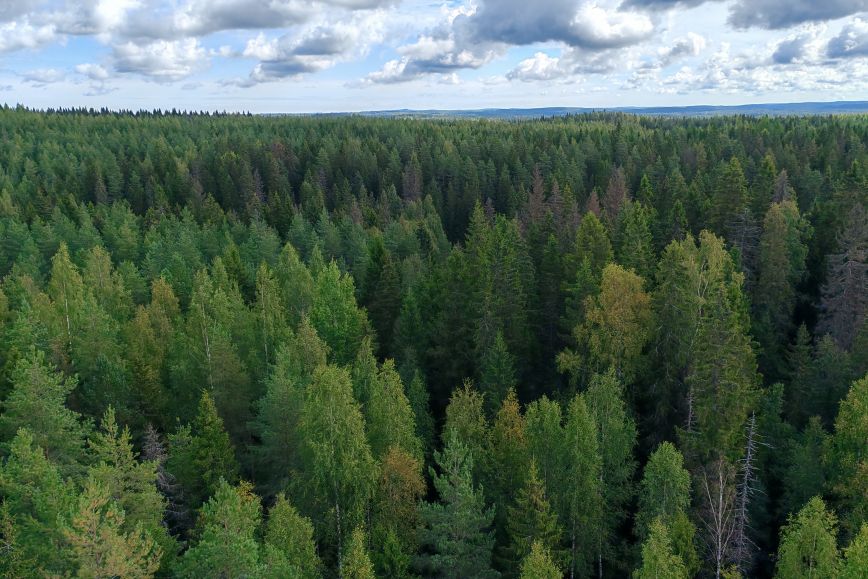
Climate change increases the frequency of heatwaves, droughts, pest outbreaks, and forest diseases which cause yearly financial losses, amounting to hundreds of millions of euros worldwide and weaken the ecosystem services provided by forests.
In a new project, funded by the Research Council of Finland, researchers from the University of Helsinki, the Finnish Geospatial Research Institute (FGI) of the National Land Survey of Finland, and the University of Oulu will combine advanced forest monitoring technologies, tree ecophysiology research, and artificial intelligence to uncover the mechanisms behind forest resilience. The goal is to identify the earliest signs of stress in trees and develop new tools for detecting risks before visible damage occurs.
The findings could have important practical benefits for forestry, environmental monitoring and climate adaptation. Earlier detection of stress would give forest managers more time to respond to drought, insect outbreaks and disease. Knowledge about why some trees success in defending themselves while others fail will support forest managers to develop better management plans to enhance the resilience of forest ecosystems.

Individual trees respond differently to stress
FGI’s LiPhe laser scanning station at the Hyytiälä Forest Station has monitored forest conditions over the past five years and produced a unique, high-resolution dataset on how trees respond to environmental changes. The monitoring period includes the severe heatwave that affected the area in 2021, as well as impacts caused by pests and other threats. The dataset contains observations from more than a thousand individual trees.
The monitoring reveals that the trees from same species growing under seemingly similar conditions do not always respond in the same way after been stressed with heat, drought or infestation. While some individuals decline to death, others may withstand or recover.
“We will study the early changes other than foliage discoloration that indicating possible tree decline”, says Research Manager Yunsheng Wang from the Finnish Geospatial Research Institute (FGI) of the National Land Survey of Finland.
Researchers will analyse three-dimensional point cloud time series generated from hourly LiDAR observations to investigate whether changes in tree structure, growth patterns, or branch movements can reveal early signs of stress. Artificial intelligence will be essential for processing and interpreting over 500 TG 3D point cloud stream data. The first results of the project are expected in the summer of 2027.
In addition to observing external changes that can be detected through remote sensing, the project will further investigate how these external changes reflect the changes in the internal ecophysiological processes of trees. By combining ecophysiological measurements with LiPhe stream and artificial intelligence, the research team hopes to connect internal processes with visible structural changes and discover more accessible signs for the status for tree vitality.
More information
Research Manager Yunsheng Wang
Finnish Geospatial Research Institute FGI, National Land Survey of Finland
050 347 8903, firstname.lastname@nls.fi
The research is part of the UNITE flagship, which studies the interaction between forests, people, and machines and is funded by the Research Council of Finland.