

Part of broader changes, variation in water levels has a major impact not only on natural environments, but also on built ones.
“Large short-term fluctuations are a burden on the environment and affect matters such as shoreline erosion, nutrient runoff and the habitats and recreational use of water bodies. Extreme fluctuations also increase the risk of flooding and cause strain to bridges, stormwater systems and other structures”, says Linnea Blåfield, a doctoral researcher at the University of Turku.
Global warming is causing several simultaneous changes
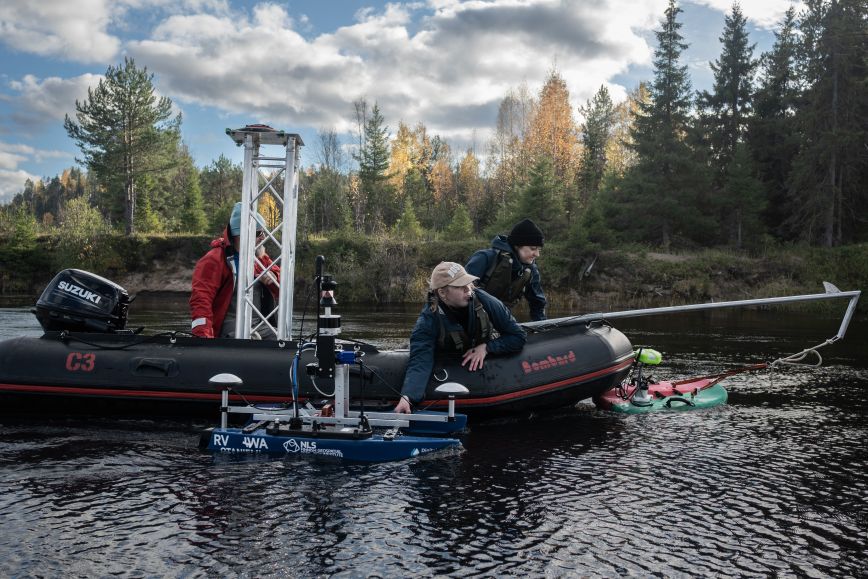
Changes in the rivers are closely monitored across Finland in studies conducted jointly by several research organisations as part of the Digital Waters project and funded by the Academy of Finland. On their latest field trip, the researchers took measurements at the Oulankajoki River in September. In addition to the Oulankajoki River, measurements are made in the Vantaanjoki River and Tenojoki River and its side branch Pulmankijoki.
The Oulankajoki area has already in the past been monitored for changes in the drainage basin, climate and river. In the long term, several simultaneous developments have been observed.
The average temperature in the region has increased by 3 degrees Celsius over the past 50 years, which corresponds to the warming predicted for the northern regions as a result of climate change. At the same time, the hydrological cycle - the natural cycle of water during the year - has changed: spring floods have decreased and the flow peaks of other seasons have increased. In addition, periods of thaw and rain have become more common in mid-winter, the duration of ice cover has shortened by more than a month and snow has started to melt earlier.
“Through these simultaneous changes, global warming changes the rhythm of the entire hydrological cycle and how water flows from the drainage basin to the river, how it behaves in the river bed and what changes it causes in the river and its surroundings”, says Linnea Blåfield.
Robot technology makes studies more precise
Long-term measurements have been expanded and revised in the Digital Waters studies. Very accurate measurement data can be obtained on even small changes with the help of cutting-edge technology, such as laser scanners attached to drones and robotic boats, underwater sensors and cameras.
In the latest field experiments, the University of Turku also tested airborne and land-based robots for the first time in waterway research. In Oulankajoki, their ability to move and operate independently in challenging natural environments also when satellite positioning is not in use was studied.
“The technology tested in Oulankajoki must also work in other environments. This ensures that the results and methods can be utilised as widely as possible”, says Research Professor Harri Kaartinen from the National Land Survey.
Technology is essential because researchers are developing methods and devices to make them increasingly precise and autonomous. Robotic boats and drones reach places that would be difficult for humans to access, and laser scanners and sensors collect data with precision that more traditional methods cannot. The aim is to produce as diverse and reliable research data as possible, which will help researchers understand and anticipate changes in the environment.
“We have many kinds of equipment in use in a small area, but instead of pertaining to just that area, the results can be generalised to similar environments both in Finland and abroad”, says Professor Petteri Alho from the University of Turku.
Further information
• Doctoral researcher Linnea Blåfield, University of Turku (changes in river environments)
linnea.m.blafield@utu.fi
• Research Professor Harri Kaartinen (drone measurement systems)
+029 531 4756, firstname.lastname@nls.fi
• Professor Tomi Westerlund (robotics)
+358 50 343 7684, tovewe@utu.fi
Digital Waters Flagship is funded by the Academy of Finland and it generates new information about waters, supports decision-making and helps in the utilisation of digital solutions in the water sector.