

Elk damage is not a marginal phenomenon: According to the Forest Centre, elk cause annual losses of at least EUR 55 million to forest owners. In addition, the quality of forests may suffer if the damaged trees grow large. To avoid damage, owners may plant spruce, even if pine is a better choice for the site.
Cost savings through more agile spraying
The drone can see better from the air than the human eye, and in the HirviDrone project, drones have been trained to distinguish between healthy and elk-damaged seedlings.
In the tests, the AI model developed by the research team succeeded in classifying about three-quarters of the seedlings based on their damage category. When the classification is successful, the right seedlings can be protected and less repellent is lost. Compared to humans, drones are fast and agile, as moving around in the seedling stand is time-consuming physical work.
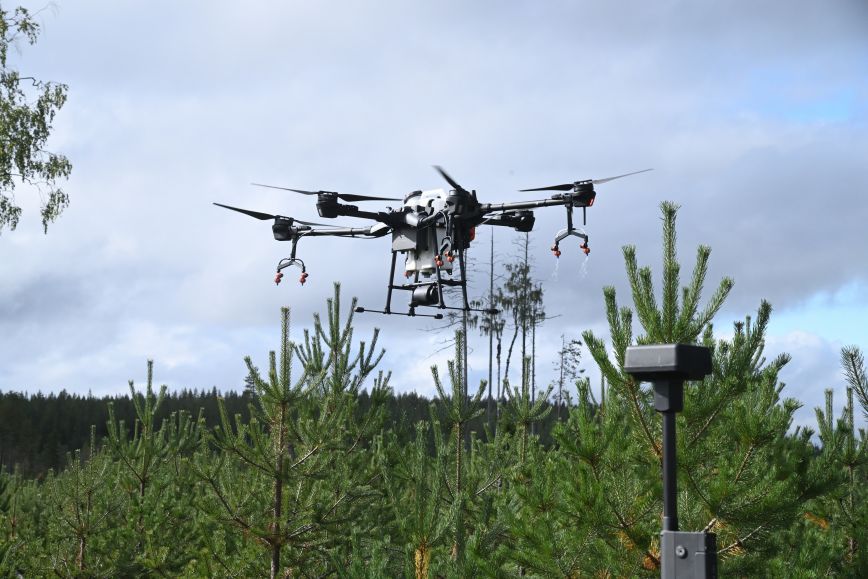
In the project, when the researchers investigated the spraying of repellent with an agricultural drone, they found it easily spreads over too large an area. Large trees and other obstacles in the flight path further complicate the targeting of spraying with a large drone. Therefore, the study also focuses on the ability of drones to fly in the forest.
“Drones are already in extensive use in agriculture, but flying in the forest has its own special characteristics, as hitting tree trunks and branches must be avoided. We are also testing a robotic drone that can navigate in an unfamiliar environment without human guidance”, explains Research Professor Eija Honkavaara from the National Land Survey of Finland.
New application requires legislative changes
A bio-based Trico repellent is used in the study.
“The active ingredient in Trico is sheep fat. Since it is a plant protection product, aerial spraying is currently prohibited for purposes other than research and development. In the project, spraying tests have been carried out with a trial operating licence in Äänekoski and Kuusamo”, says Project Manager Venla Wallius from the Finnish Forest Centre.
Spraying tests were carried out on jointly owned Kuusamo forest’s test plot at the beginning of September. In seedling stands, repellent spraying was tested both on predetermined seedlings and as zonal spraying. Later, the effect of the spraying of repellent on the damage caused by the elk will be compared to the traditional method, where the agent is applied manually using a backpack sprayer.
Putting the research results into practice will require changes to the legislation. It is likely that, for example, spraying drones already approved for fertilizer use will also be accepted for the spraying of repellent as legislation at national and EU level develops. Now is a good time to develop drone technology to make it more suitable for preventing elk damage.
HirviDrone is a European Innovation Partnership (EIP) project with funding from the EU’s rural development fund. The funding has been granted by the Häme Centre for Economic Development, Transport and the Environment, whose tasks are managed by the Economic Development Centre of Southeast Finland.
Further information
Project Manager Venla Wallius
Finnish Forest Centre
050 431 8610, firstname.lastname@metsakeskus.fi
Principal Research Scientist Juho Matala
Natural Resources Institute Finland (Luke)
040 801 5275, firstname.lastname@luke.fi
Research Professor Eija Honkavaara
Finnish Geospatial Research Institute FGI, National Land Survey of Finland
040 192 0835, firstname.lastname@maanmittauslaitos.fi
Game Manager Jani Körhämö
Finnish Wildlife Agency, Northern Häme
029 431 2281, firstname.lastname@riista.fi
