

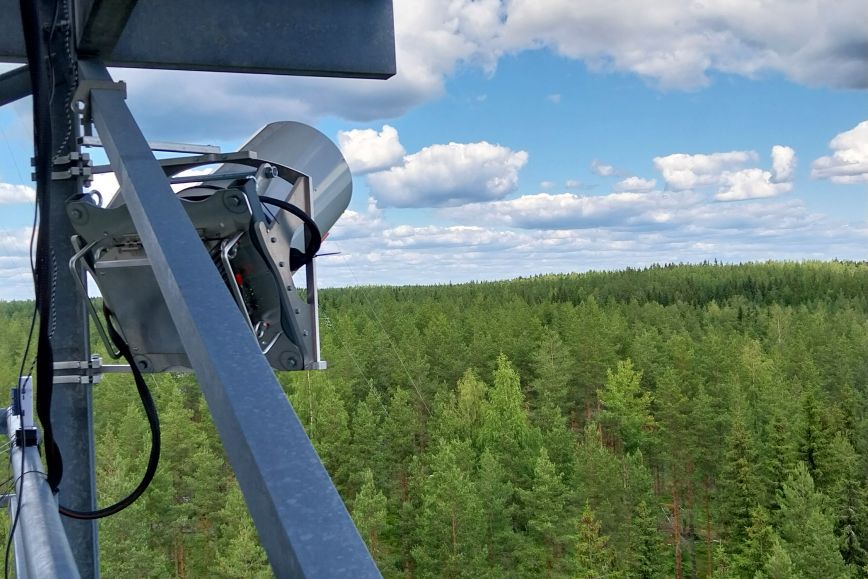
The study was carried out by laser scanning a group of trees once an hour for several consecutive days in the Hyytiälä research forest. Days when wind or rain did not affect the movement of the trees were chosen as the monitoring period.
The systematic movement of dead branches had long been suspected, but it had not previously been possible to accurately measure it under natural conditions. Using autonomous laser scanning, the researchers were able to follow even the smallest movement of the branches accurately and systematically.
The modelling showed that all the examined branches, from 16 coniferous trees and from one deciduous tree, followed a clear and systematic movement pattern during the day.
The dead branches of conifers moved down during the day and up at night, while birch branches behaved the opposite way. The tips of the branches moved up to 43 centimetres vertically in just a few days.
Dead branches react to humidity
According to the study, the movement of dead branches is due to environmental factors, and variation in air humidity plays a key role. Depending on the relative humidity difference, the wood material either binds water from the air or releases it, causing the wood to expand or shrink. A delay was observed in the branches' movements relative to the moisture content: the movement followed the changes in humidity with an average delay of about 3.5 hours.
The same phenomenon can be seen, for example, in the warping of sauna benches or terrace decking.
“The reaction of wood structures to moisture was known, but the verification of the phenomenon in living trees is new. A long time series with laser scanning helps to detect even small changes in trees systematically”, says Associate Professor Eetu Puttonen from the National Land Survey.
In addition, the study showed that the movement patterns of living and dead branches differ markedly. Monitoring this phenomenon can help develop new methods for identifying dead or dying tree parts.
A research method based on laser scanning time series has previously found that trees "sleep" at night and that even trees of the same species wake up in spring at their own times.
The research was funded by the German Research Foundation (DFG), the Research Council of the Academy of Finland and the Tulanet postdoctoral programme of Finnish research institutes.
The peer-reviewed study has been published as an open-access article in Agriculture and Forest Meteorology.
Further information
Associate Professor Eetu Puttonen, Finnish Geospatial Research Institute FGI
+358 29 531 4868, firstname.lastname@nls.fi