

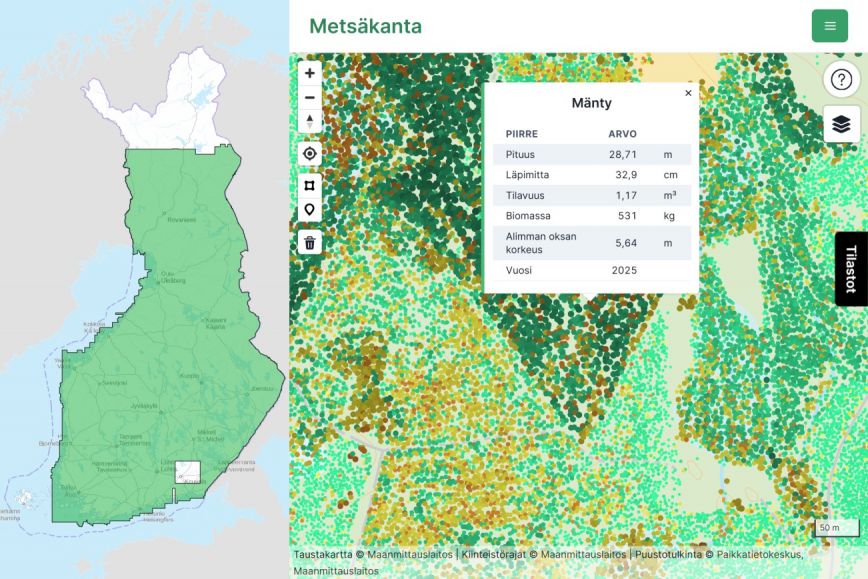
The forest database, a project of the Finnish Geospatial Research Institute FGI, is an inventory of the nation’s forests that goes down to the individual tree. Its material has been produced in the national laser scanning programme. The database began as an experiment, with data first mapped from a small test area.
Now, the database covers most of Finland. The forest database is currently one of the world's largest of its kind and, as far as we know, the largest information system about single-tree forest resources. Updates to the database are no longer planned, but the lessons of the study will be used elsewhere in the future.
“The forest database has shown that single-tree forest resource information can be produced on a national scale. We gained valuable practical knowledge on what needs to be taken account of in the production of information like this, what kind of technical and material challenges arise as it is scaled up, and what kind of development needs there still are in the methods,” according to Matti Hyyppä, main developer from the National Land Survey of Finland.
Forest information, drilled down to the single tree
In traditional region-based forest resource data, the forest is described as grid squares or forest stand polygons, among other methods. These enable, among other things, estimates of average tree characteristics and total quantities.
In the individual tree method, the focus is on single trees and their characteristics. Laser scanning data allows the identification of tree locations and to estimate their height, diameter, volume, biomass and species.
Single-tree data enables the forest structure to be examined in more detail than data based on regional averages. In the future, it may support forest management and logging plans, monitoring changes in forests, and a more detailed description of the structure and diversity of forests.
“A system like the forest database makes it possible to preserve tree-specific biodiversity. It is a kind of digital twin of the forest, which can also be combined with the decision-making algorithms of a harvester to mark the trees that you shouldn’t cut down,” says Matti Hyyppä.
Study also revealed areas for development
One of the biggest restrictions of the research method is the identification of small trees. The current data in the forest database is based on airborne laser scanning, where the tops of larger trees can block smaller trees from being detected. It can detect, for example, about 90 percent of the logs, but significantly fewer small trees.
This is set to improve down the line, as the point density of the new data from the national laser scanning programme will increase from about 5 to 20 points per square metre in general. Denser laser scanning data is a far more detailed description of the structure of the forest. Combining denser data is with emerging deep-learning AI methods, it will become possible to identify a significantly larger proportion of even small trees.
“It will be possible to develop single-tree forest resource information with denser laser scanning data and new artificial intelligence methods,” says Matti Hyyppä.
The study is part of the UNITE Flagship of the Research Council of Finland, exploring the interaction between forests, humans and machines.
Further information
Researcher Matti Hyyppä, Main Developer of the Forest Database
+358 29 531 5137, firstname.lastname@maanmittauslaitos.fi